 50 pages
Floral
Botanical Coloring Pages
The only floral set drawn as full scenes rather than single stems — meadows, river banks and butterflies in flight rather than a…
See all 50Fine, layered linework for a long sitting. Mandalas built from repeating rings, dense rainforest with almost no bare paper, gingerbread houses tiled roof-shingle by roof-shingle. These are the slowest pages in the library, which is exactly why people choose them.
Largest sets first. Each card opens a gallery where every thumbnail is its own printable PDF.
50 pages
The only floral set drawn as full scenes rather than single stems — meadows, river banks and butterflies in flight rather than a…
See all 50 50 pages
Baubles drawn as circular mandalas — bells, bows, snowflakes and stars arranged in symmetrical rings.
See all 50 50 pages
Tall hats, braided beards, lanterns and heavily decorated uniforms.
See all 50 50 pages
The wing panels are the point here: each one is subdivided into cells you can treat as a tiny stained-glass window, with the flowers underneath left as the quiet…
See all 50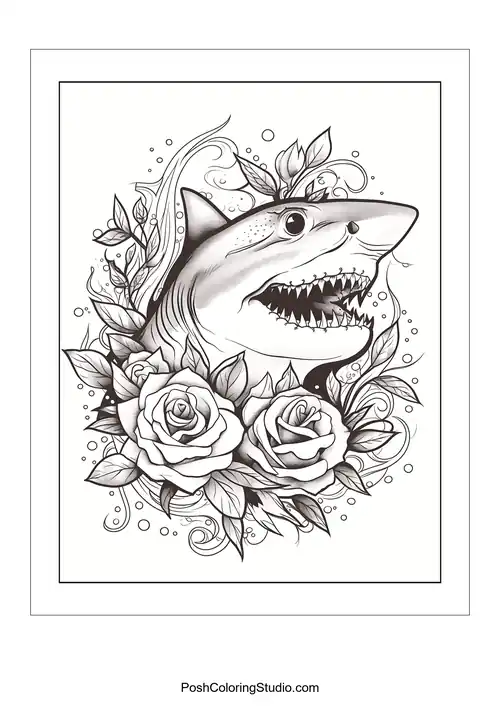 50 pages
An unlikely pairing that works: shark heads emerging from arrangements of roses, with decorative swirls and water droplets filling the gaps.
See all 50 50 pages
Wolf heads pushed through dense foliage and flowers, with the fur drawn in long flowing lines that run straight into the leaves around them.
See all 50 50 pages
Dense, layered jungle with pathways cut through it.
See all 50 50 pages
Twisted trunks, dense canopies and mushroom-lined paths, with the occasional cottage set back in the trees.
See all 50 48 pages
Mushroom caps covered in swirling pattern and spots, grouped four or five to a page with foliage filling the gaps.
See all 48 50 pages
The roof tiles, gumdrops and piped icing are drawn individually, so a single house can hold an evening.
See all 50 50 pages
Drawbridges, battlements, winding staircases and rounded fairy-tale towers.
See all 50 50 pages
Far darker than the cute ghost set — flowing hair, skulls, reapers and dense ornamental line work, closer to a tattoo flash sheet than a trick-or-treat page.
See all 50 50 pages
No subject at all — fifty pages of swirling lines, leaf shapes and curling waves.
See all 50 50 pages
Wolves and lions drawn as mandalas — the mane and the fur become the repeating pattern, so the symmetry is built out of the animal rather than placed behind it.
See all 50 50 pages
Built outward from a single central bloom, with layered petals, leaf motifs and dotwork filling each successive ring.
See all 50 50 pages
Fifty rectangular panels built on radial symmetry rather than circles.
See all 50 50 pages
Fifty lion faces where the mane does the ornamental work, spiralling outward in patterned sections around the muzzle.
See all 50 50 pages
Lions and zebras given the mandala treatment — the zebra pages are the interesting ones, where the real stripes and the drawn pattern start competing.
See all 50 30 pages
Bouquets in decorative vases, tied with ribbon, mixing several flower types per page.
See all 30 30 pages
A second bouquet set, leaning more on daisies and detailed leaf work than on the vases that hold them.
See all 30 24 pages
Twenty-four wolf faces, several of them set inside a circular frame so the animal and the mandala share one outline.
See all 24 10 pages
Ten snowflakes, each drawn as a genuine six-fold symmetrical structure with hexagonal centres and branching arms.
See all 10An intricate page is not a harder version of a simple one — it is a different activity. You are not trying to finish it tonight. The appeal is the rhythm of filling one small cell after another, which is the part that quiets the mental noise, and it only works if you stop treating the finished page as the point.
Fine linework punishes a blunt pencil and a thick nib. Keep a sharpener within reach, work at lower pressure than feels natural, and build depth in layers rather than pressing hard once. A 0.3 mm fineliner reaches places a pencil cannot, but it is unforgiving — test it in a corner first.
The most common mistake on a dense page is colouring all of it. Decide early which areas stay as bare paper and protect them. White space is what makes the pattern read as pattern rather than as noise, and it is the one thing you cannot add back later.
No account, no email address, no watermark. Browse the whole library by theme or by how much attention you have left today.
Browse the library